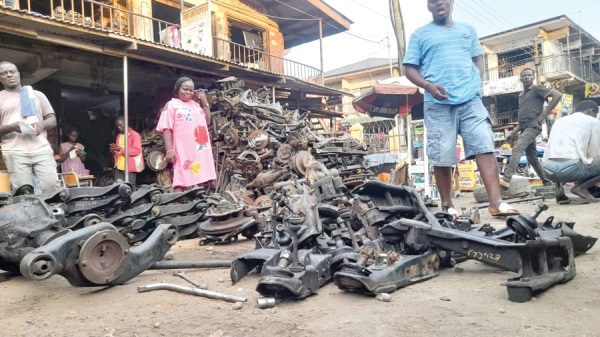
Despite the recent strengthening of the Ghanaian cedi against the US dollar, some spare parts dealers at Abossey Okai are refusing to lower prices.
Their position is driven by the fact that their current stock was imported when the exchange rate was significantly higher, making any immediate price cuts financially unsustainable.
This approach contrasts with calls from the Abossey Okai Spare Parts Dealers Association, which has encouraged members to reduce prices in line with the cedi’s recovery.
Dealers argue that they must first sell off existing inventory acquired under less favourable exchange rates before passing on any potential benefits of the stronger cedi to consumers.
Speaking to journalists, Francis Appiagyei, a dealer at Abossey Okai, explained:
“For now, maybe it can’t be possible because we ordered the goods at a certain rate, which is higher than what we are seeing now.
“With that price we have to sell, and when the goods finish and you are ordering another one with a reduced [exchange] rate, then definitely the prices will come down.”
Premature price reductions, they say, would lead to losses and threaten the viability of their businesses.
However, there is cautious optimism that prices may decline in the near future.
Another dealer, Yaw Ansong, expressed similar concerns about financial sustainability if prices are slashed prematurely:
“Unless I sell the one which I already ordered and finish before I can reduce the [price] of the goods. I haven’t ordered new one so I can’t reduce the price. If I reduce the price I am going to lose my job,” the traders said.
While consumers may be eager for immediate relief, many dealers maintain that pricing decisions must be grounded in economic realities, not public pressure.