


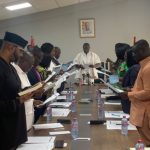
On Day 2 of the Greater Works Conference at Christ Temple East, Tse Addo, last Tuesday, August 5, when Conference Host Pastor Mensa Anamoa Otabil was handed the mic to introduce the next speaker, it was 20 minutes of what I choose to describe as a panegyric.
The next speaker was the man popularly believed to be Nigeria’s most significant religious export to the world, Pastor Matthew Ashimolowo, founder of Kingsway International Christian Centre (KICC).
For the first time since Pastor Matthew began ministering at Greater Works, Otabil’s introduction was not about his friend’s eloquence or ministerial gifts.
He introduced the audience to Widows Empowerment, a charity through which Ashimolowo donates to the poor.
At one such event in Nigeria, he donated food, clothes, medical treatment, money and other items to some 1,500 widows in Ode-Omu, Osun State, Nigeria.
I was in the Greater Works crowd and if you watch the event on Youtube or Facebook, you might see that I was one of those applauding the act of philanthropy by this pastor who has been honoured on the Power List on more occasions than one as the Most Influential Black Person in the UK’s Public Sector (Religious Category).
My applause was inspired by a verse in the Christian Bible’s Proverbs 19:17, which says that “Whoever is kind to the poor lends to the Lord.”
I am also one who believes that Christians should respond positively to global poverty and hunger; that a nation’s greatness is measured by how it treats its weakest members. Mahatma Gandhi’s observation is true for all time, that “there are people in the world so hungry that God cannot appear to them, except in the form of bread.”
But even as I clapped, the other side of my brain was taking note that whilst giving fish to the poor is great for now, shouldn’t Christians rather teach the poor in their congregations how to fish?
Method
That is why I love the method of the early missionaries.
They established schools to get the poor educated because it was the most assured way of empowering them to use their brains to help themselves out of poverty.
They created vocational schools to teach such skills as carpentry, pottery, shoe-making, blacksmithing, etc.
In reacting to news that Ghana’s sitting President is a farmer, a member of the John Dramani Mahama Fan Club wrote the following online: “Hi there.
I want to suggest to all churches in Ghana to contribute 45 per cent of church-offering to boost Ghana’s Agriculture…”
That said, it’s for me. The church should respond to crises, as it has always done, but long after the crises, the poor keep sitting in the pews.
The answer for all time is to use the church money to set up farms and plantations.
Sustainability
It should be a programme of sustainability.
The church should acquire the land and the inputs, such as seed and a watering mechanism for irrigation and enter into a contract with as many in the congregation as will be interested.
Since they have no means of feeding while they weed and plant, the church should feed them during the period of planting.
At harvest time, as they earn the reward of their labour, they can be weaned off charity.
Can we imagine the millions that will be lifted out of poverty?
Beyond the individual in the church, the nation benefits. When Mohammed Yunus established Grameen Bank, which lent to the poor (even beggars), millions were taken out of extreme poverty and the country experienced peace and stability.
He won the Nobel Prize for that initiative. I am sure this contribution is behind the decision of the current President of Bangladesh to appoint Yunus as head of an interim government.
With the size of offerings and tithes that come in every day, every week, every month, there is nothing the church cannot do that requires the use of money.
Unlike many other people who criticise the churches for putting their money into new buildings, I am impressed by the size of new church auditoriums that have been sprouting over the last 10 years or so.
Investment
Their current investment in large church buildings prevents a situation where, after 50 years, the congregations have no place to sit.
In Accra, I have taken note of developments by Calvary and Mount Olivet Methodist, Perez, Christ Temple East, etc.
Wise decision, if such ventures are not overdone to the neglect of the needs of the poor.
For example, while the poor cry for help, churches can postpone their investment in disco strobe lights, etc.
I am not against investment in gadgets and equipment that will attract and keep the youth interested in going to church.
What I am against is doing all these to the neglect of the poor.
Let’s have church farms whose farmers and workers are in the church.
If each denomination sets up a 1,000-acre plantation, we shall, in the next five years, be counting one million fewer people among the poor in the church.
The writer is the Executive Director,
Centre for Communication and Culture.
E-mail: ashonenimil@gmail.com












Creating jobs especially for the church congregants (youth, and redundant adults) will go a long way to moving forward through Christ. Giving charity to the poor and needy is most important bcos the Lord said they always will be with us since there are people through no fault of theirs can never get themselves to do anything and this isn’t laziness but something unexplainable. The Pastors knows best as to what jobs they are to create to help themselves and the followers. God s guidance be with you all The world will and can heal with humility and prayers. I believe.Amen