

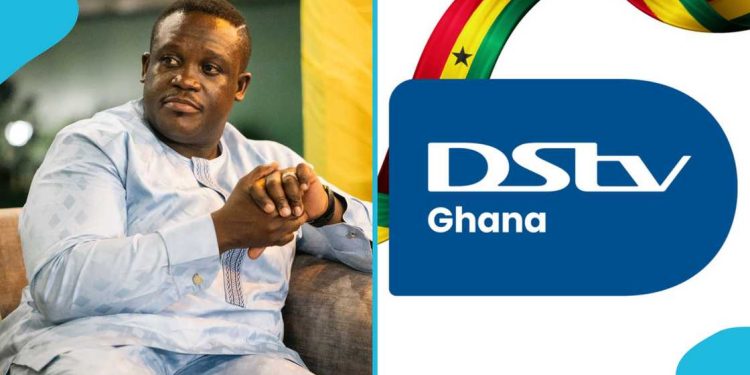
How can economic theory save DSTV from Dzata’s claws?
Once regarded as a luxury acquisition in many Ghanaian homes, DSTV now stands on the cusp of losing its operational license come September 6, 2025.
The upscale TV channel, a product of Multichoice Ghana, faces its toughest opposition yet to its monopoly, not from a competing brand, but from the government of Ghana. Ghana travel guide
Recent tensions between it and Ghana’s action-oriented Minister of Communications, Digital Technology, and Innovations, Sam Nartey George, Hon., present a fascinating conundrum for the TV provider.
DSTV and the government, acting through the tough-talking minister, have been in a heated tango over a pricing package that satisfies both provider and consumer. In fairness, the Minister’s radical actions only re-echo the prevailing sentiments held by many that DSTV has been discriminating against the Ghanaian consumer vis-à-vis other African countries in which it operates, especially Nigeria. The company has denied this allegation and defended its pricing model in Ghana, citing a weakening cedi and macroeconomic instability, amongst others, as justification for the price disparity between Ghana and Nigeria (perhaps after accounting for exchange rate differences).
Now, as DSTV faces a September 6 deadline given by the Minister to conform to the government directive to reduce its price by 30% or risk losing its operating license, the question that begs for answers is, will DSTV come out unscathed after September 6? What are the economic theories that will inform DSTV’s position to maintain its prices, and how will it affect the continued viability of the company in the Ghanaian market?Ghana travel guide
Economic theory to DSTV’s rescue?
While the debate on this matter remains unabated, what is often missing in the heated public debate is what economic theory predicts in this kind of situation. In this article, I shed light on the economic theory of price discrimination (which, I believe, is at the core of this disagreement) and other economic variables and how that might explain the price differential for the same service/good in the different markets and potentially serve as an unlikely arbiter in this disagreement. For simplicity and contextuality, I focus on Ghana and Nigeria, two markets that present a unique opportunity to discuss the real-world implications of theory.
Price discrimination
From economic theory, price discrimination is said to exist when a producer charges different prices not because of asymmetry in cost, but instead because of differences in consumers’ willingness to pay (WTP). While different types of price discrimination exist—first degree, second degree and third degree—first postulated by Pigou (1920)—the focus of this article is the latter. Unlike first degree and second degree, which respectively discriminate based on the consumers’ WTP and quantity procured, the third-degree price discrimination is based on charging different prices to consumers/markets based on their elasticity of demand. Thus, the latter is more relevant to a monopolist like DSTV because two different markets are involved.Ghana travel guide
From ECON 101, elasticity measures consumers’ responsiveness to price changes. Now, third degree price discrimination postulates that the seller should charge a lower price to the more price elastic market and a higher price to the less price elastic market (or inelastic). In this context, it says a monopolist—or near-monopolist like DSTV—charges lower prices in markets that are more price sensitive (elastic) and higher prices in markets that are less price sensitive (inelastic). Elasticity is also directly related to the availability of substitutes. By a rule of thumb, a good with more substitutes is more elastic and vice versa. There is virtually no rival service provider to the type of services DSTV offers, premiership soccer, Big Brother, Soap Operas, International News, etc. Whereas in Nigeria there are alternatives like GoTV and SLTV. Consequently, DSTV stands the risk of losing market share if its prices are way above GOTV (it can do so if it has some differentiating programs that consumers demand).
Population dynamics
Population also plays a role. Nigeria is a very large market, in fact about 10 times as large as Ghana. That means the company can afford to charge a lower price and still be profitable, all else equal by spreading its fixed cost over a large customer base. Whereas in Ghana, with its 30 million population, it may not necessarily have the subscription base to cover the fixed costs associated with providing the service, which may consequently warrant a price premium. What is this fixed cost?Ghana travel guide
Although DSTV provides several services, I want to focus on the English Premier League (EPL) for simplicity of my arguments. MultiChoice Group (mother company of DSTV and SuperSport) owns the broadcasting rights to the EPL in Africa. So, here is where the fixed cost comes into play. The rights once acquired come with a certain fixed cost, in addition to other fixed costs related to infrastructure in broadcasting these services via satellite or other media. Think of a 30-seater bus that must still burn the same fuel whether it carries 30 passengers or just 10. Unless the bus is full, fares per passenger must rise to cover the cost. This might be the scenario at play with DSTV operations in Ghana and potentially explain the price disparity between Ghana and Nigeria. The same could explain why competing companies like Gateway that had the right to broadcast EPL sometime around 2007/08 failed to establish themselves in Ghana. I mention this because, during my time managing the DSTV account for Unity Hall at KNUST, we noticed a clear difference when Gateway entered the market. On several occasions, even after our subscription had expired, we still had access to their service, meaning consumers were enjoying it without paying. That was never the case with DSTV. The implications are that Gateway did not have the necessary infrastructure in place to run the service effectively and efficiently. As you may expect with an inefficient entity, their operation in Ghana was a flash in the pan, and by the next season or so DSTV pushed them out. It could yet be the case that DSTV is a natural monopoly because of the high fixed cost associated with providing the service.Ghana travel guide
Unique Content
Another plausible justification for the price disparity is the content. Nigerians offer several competitive programs on DSTV. The shows that command large viewership are Big Brother Naija and Nollywood movies. Given this viewership, advertisers will be willing to pay more to advertise on these shows, and that could translate to lower subscription fees because the company can recoup the forgone revenue through selling commercials. It then begs the question; how many Ghanaian companies advertise on DSTV?
Regulation
Yet, with all the foregoing, the government also has the regulatory power to intervene in the market if the government deems DSTV to be charging unjustified monopoly prices to consumers. The problem with a monopoly is the distribution of welfare gains from charging prices above the competitive price. Given that the government is seeking a 30% price reduction, could it be a reasonable rationalization that DSTV may be internalizing too much of the monopoly gains? Perhaps, DSTV could demonstrate that consumers get their fair share of the cake through the provision of public amenities and other social interventions. Yet, if indeed Ghana is a free market economy, which I deem it to be, price regulation must not be entertained especially given that DSTV service is a club good and not a critical public good like healthcare.Ghana travel guide
Overall, Ghana is a footballing nation, and we love the thrill and excitement associated with the EPL and are willing to pay what it takes to enjoy these games. Ultimately, the question is whether the current price is beyond the willingness-to-pay of the Ghanaian consumer? If the answer is affirmative, DSTV will be out of business in Ghana. However, that is yet to be the case. Or is it the case that few who can afford are being charged high prices, perhaps explaining why household subscriptions are low relative to business places like bars and pubs? Nevertheless, we want a solution to this impasse before September 6, because we love soccer, the EPL just started, and moreover, we want to watch Kudus live in action in the year he gets crowned as the world’s best footballer.
These indeed are trying times for DSTV, and DSTV must navigate these turbulent waters with tact to keep itself afloat.
Writer: Festus Attah Ph.D. Candidate Applied Economics, Auburn University | Email: fsa0005@auburn.edu