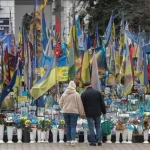
On Tuesday morning, crowds of people lined up outside designated memorial sites to leave flowers and pay their final respects to Abe, who dominated Japanese politics for a generation.
But as they mourned, thousands of others took to the streets in anti-funeral protests across Tokyo, illustrating a deep public divide over the occasion, Japan’s first state funeral for a Japanese leader since 1967.
Some crowds chanted slogans as they marched near the funeral venue, waving banners that urged a stop to the proceedings.
Protest leaders rallied the crowd through loudspeakers, and a van rolled past with music blasting from a boom box.
The protests grew tense at times, with several loud confrontations and scuffles between demonstrators and police.
Abe’s death sent shock waves through Japan and the international community, with thousands of mourners gathering in Tokyo in July as his private funeral took place. But in the months since his assassination, the outpouring of grief has given way to a growing discontent.
Abe’s state funeral comes as the country grapples with rising inflation and anger stemming from revelations that half of Japan’s ruling party members had ties with the controversial Unification Church which has faced backlash over fundraising practices.
Some critics have also pointed to Abe’s more unpopular policies while in office as a reason for the shift in mood, and questioned why so much taxpayer money is going to the state funeral – which will cost some $12 million (1.66 billion yen) – at a time of acute economic strain.
“It was a tragedy that Abe was gunned down and lost his life, but we shouldn’t make him a hero out of this tragedy,” one protester, Shinsaku Nohira, told CNN at a recent anti-state funeral demonstration outside Japan’s parliament.
“At least half of Japan’s population is against this state funeral, so I don’t want the government’s messaging to get out there, I want people out there to know that there are citizens in Japan who are opposing this event.”
An opinion poll by NHK earlier in September showed that 57% of respondents opposed the state funeral, compared to 32% who supported it – and the rest said they didn’t know, or declined to answer.
Prime Minister Fumio Kishida has tried to appease the public, saying a state funeral for Abe was “fitting” given his achievements as former leader. The ceremony is not meant to “force people to mourn” or to become a “political issue,” he said in August.
Abe held office for two separate terms, during which he transformed Japan’s security posture, raising questions over the country’s status as a pacifist nation, and passed a major security legislation in 2015 that expanded what Japan could do militarily to support the US.
He also was a prominent figure on the world stage, cultivating strong ties with Washington and seeking better relations with Beijing – while also trying to counter Chinese expansion in the region by uniting Pacific allies.
One of his final successes in office was securing the 2020 Tokyo Olympics – though the Covid-19 pandemic forced the competition to be postponed to 2021.