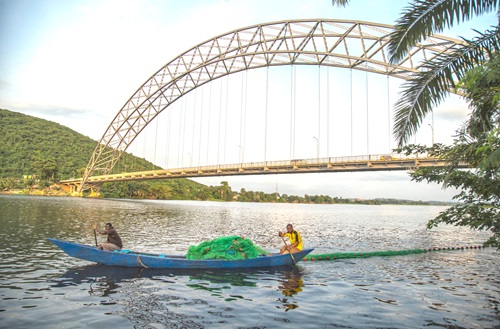
As Ghana joins the global community to celebrate World Water Day, our attention turns to the vital water resources that sustain our nation.
This year’s theme, ‘Glacier Preservation’, serves as a reminder of the importance of preserving our water sources.
Although glaciers are not featured in Ghana’s geography, our country is blessed with an abundance of water resources, including rivers, lakes and wetlands.
Among Ghana’s many water resources, Volta River is the most notable for its sheer size, importance and impact on our national development.
The Volta River has its roots in the Bobo-Dioulasso highlands of Burkina Faso, from where it flows south into Ghana.
It is said that the river’s name originates from the Portuguese word “volta,” meaning “twist” or “turn,” which refers to the river’s curved course.
The river, which is the ninth largest in Africa, stretches approximately 1,500 kilometres from its source to the estuary, where it enters the sea at Ada.
Its basin covers 407,093 square kilometres, spanning across Ghana, Burkina Faso, and the Ivory Coast.
The river’s tributaries, including the Black Volta, White Volta, and Red Volta, contribute to its vast network.
The River Volta’s most significant feature is the massive Lake Volta reservoir created by the Akosombo Dam.
The Volta Lake is the largest man-made lake in the world by surface area, covering an impressive 8,502km².
With a capacity of 148km³, Lake Volta is also the third-largest artificial lake in the world by volume.
Its shoreline stretches 7,250km, and its massive size makes it visible from space.
The river is a lifeline for Ghana, supporting various sectors of the economy.
One of the ways it contributes to the country’s development is through hydroelectric power.
The Akosombo Dam on Lake Volta generates electricity for the country, making it a crucial source of renewable energy.
In addition to powering the country, it also supports agriculture.
The lake’s waters irrigate crops, helping farmers and their communities make a living.
This has a significant impact on the livelihoods of people living along its banks.
It is also home to a diverse array of fish species, providing a source of income for fishermen and a vital source of protein for local populations.
Furthermore, Lake Volta serves as a transportation route, facilitating the movement of goods and people.
As we celebrate World Water Day, it is essential to recognise the significance of the Volta River and its contribution to the country’s development and work towards ensuring its sustainability for years to come.