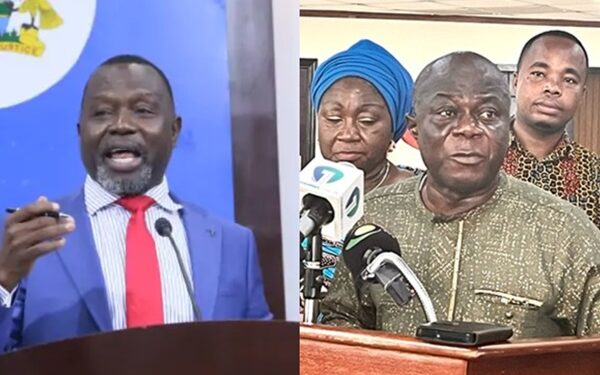
The Minority in Parliament has issued a strong demand to the Attorney-General, Dr. Dominic Akuritinga Ayine, calling for the immediate reversal of his decision to discontinue the high-profile criminal case against Dr. Kwabena Duffour and seven others.
Failing that, they warn, they will take the matter to court.
Speaking at a press briefing in Accra on Monday, July 28, Ranking Member on the Constitutional and Legal Affairs Committee, Kwame Anyimadu-Antwi, sharply criticised the Attorney-General’s entry of a nolle prosequi, a legal declaration that drops charges in the case of The Republic v. Kwabena Duffour & 7 Others.
The case involved allegations of serious financial crimes uncovered during the Bank of Ghana’s financial sector clean-up, with UniBank at the centre of the controversy and an estimated GH¢ 5.7 billion allegedly unaccounted for.
According to Anyimadu-Antwi, the Attorney-General’s decision is not only legally questionable but ethically dangerous, posing serious implications for public accountability and the broader fight against white-collar crime in Ghana.
He took particular issue with the Attorney-General’s justification, which cited a newly introduced “60% recovery threshold” as grounds for halting the case in the national interest.
This benchmark, outlined in a press release dated July 22, was allegedly met by the accused, thereby justifying the decision to end prosecution.
READ ALSO: A-G drops case against Kwabena Duffour, 7 others
However, the Minority is challenging the legal foundation and transparency of this standard.
Anyimadu-Antwi questioned the legitimacy of such a policy, asking where it originated, whether it had ever been disclosed publicly or approved by Parliament, and why no court-supervised plea bargain or conviction was pursued, as required under Section 35 of the Courts Act.
He argued that the Attorney-General’s approach sidesteps well-established legal procedures and fails to uphold the principles of criminal justice.
In particular, he highlighted that restitution arrangements in criminal cases must be court-supervised, and not decided unilaterally by the prosecution.
Raising further concerns, Anyimadu-Antwi questioned whether a potential conflict of interest existed, asking if Dr. Ayine had ever served as legal counsel to Dr. Duffour before he was appointed Attorney-General.
If so, he said, it would raise serious ethical and procedural concerns.
He urged Parliament, the Ghana Bar Association, civil society groups, and the general public to take a stand against what he described as a dangerous precedent that threatens to erode confidence in the rule of law.
He stressed that “justice must not only be done but must be seen to be done,” reaffirming the Minority’s commitment to defending the integrity of Ghana’s legal system and promoting public trust in judicial processes.